Scan of plate in book on Joan of Arc, described as "Joan's Vision" (Photo credit: Wikipedia)
Icons are not as easy to fathom as we might like. Too many of them have become enshrined in a country's sense of identity and then crossed over as s pure symbol for a philosophy or political ideal. Finally, they make their way into a universal representation of something that dares defiance. Joan of Arc is a prime example. I struggle to find something that properly grounds the person and separates the myth. The below book wasn't the answer.
I came to this book purely by chance. It wasn’t reviewed or recommended to me. I have a rather omnivorous taste in most things and history is no exception. However, if there is an area that attracts my attention more than most it is the dissection and deconstruction of historical icons. I love myths and legends, and part of the process of appreciating a fictionalized story is distilling the actual facts. It seems like a bizarre motivation and against the normal persuasions of a romanticist, but I have never claimed to be a straightforward personality. When one considers that I have a keen interest in endorsing critical thinking, it all makes a bit more sense. Nevertheless, “Beyond the Myth: The Story of Joan of Arc” has never made any sceptical reading list I have seen. I chose it because I wanted to read a compact and comprehensive description of Joan’s life and the title perked the interests I have already mentioned.
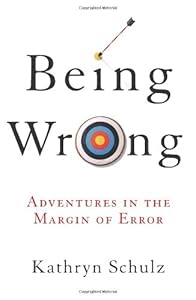
Cover via Amazon
When was the last time you admitted to being wrong about anything? It is a question that journalist Kathryn Schulz has pondered for some time, so much so that her book, "Being Wrong: Adventures in the Margin of Error", appears to be a veritable bible on something she calls "wrongology". This work investigates, dissects and embraces the whole concept of wrongness, letting no one off the hook in its research and conclusions. Being fully aware of the many ways that error has helped shape the way we progress as a species, she takes first half of Alexander Pope's famous idiom "To err is human" literally and explores the truth of this statement at great length. As Schulz, explains in her opening chapters this is not book about forecasting errors, but more about how we as deal with errors and how we can use them to our advantage.
The book is divided into four parts: "The Idea of Error", "The Origins of Error", "The Experience of Error" and "Embracing Error". Each part is divided into different numbers of chapters. The first and fourth parts only have two chapters a piece and act introductory and conclusive bookends to the whole piece. Schulz's tour of the way error affects and changes us as human beings is contained within the two meatier parts, containing six and five chapters respectively. Despite coming under the category of "Popular Psychology/Philosophy" the whole book is handled like a scholastic work. It is footnoted on many of its pages to provide fascinating additional information on certain case studies and has meticulous endnotes to provide all of the book's reference material.
Timothy Leary’s “Evolutionary Agents” is not a book you would immediately associate with Geoff Thompson’s Real Combat Method. I doubt even Leary - with his leftfield views - imagined that his lucid and controversial work would become set reading material for a class training to get certification in self-defence instruction. Yet there we all stood in a circle being questioned by Geoff Thompson, himself, about our thoughts on the work.
In truth the course was far more than a simple “hard skills” course for training how to deal with a violent situation. Most of the students who went on the course already had instructor level certification in one respected realistic combative form or another. My take on Geoff’s decision for making such books s Leary’s compulsory homework for all who attended the course was because they prompted an internal battle. This is what might be termed “Cerebral Self-Defence” or, as Geoff once put it, “Self-defence is defence against the self”.
There is nothing quite like tackling what might be called “Challenging Material”. Such material is best when it scares you and it has clearly scared others in some way. It should scare you not only because it challenges your beliefs, but because in some way it reinforces them. Geoff presented us with various books that acted as such cerebral weight training material. He did not expect us to agree with all the books in their entirety it is impossible that anyone could, given the diversity of their individual philosophies but to draw positive inspiration from each and every one of them.
Generally speaking, we were all on easy footing with books like “The Gift of Fear” by Gavin De Becker a book treated like a bible in my own self-defence class and “Man’s Search for Meaning” by Viktor Frankl; however, it was clear that Yogananda’s “The Autobiography of a Yogi” would herald in the more controversial and abstract information. Out of these texts, Evolutionary Agents was one I found the biggest personal challenge.
Let’s get one thing straight, “Evolutionary Agents” is not, technically speaking, heavy reading. In fact, the first thing that impressed me about the book was the way its author got things moving from the start. In fact, the simplicity of the prose is quite daring. It is written as if the author was feverishly scrawling down his thoughts as they rushed into his mind, not stopping to take a breath and then rushing to the finish line. This might not be too far from the truth given Leary’s proud stance on the controlled use of hallucinogenic drugs, LSD in particular, to improve man’s capacity for creativity. In fact, he was part of a movement of controversial authors who aggressively promoted this theory and practice. The pace of Leary’s writing style is in line with his argument regarding pace and mobility - the back of his book states that it is not the survival of the fittest, but the survival of the fastest. He likes his play on language and gives an interesting definition for the “Human race” in this instance.
Timothy Leary goes to great pains to explain the direction all natural progression moves. His all encompassing philosophy sees everything as a race through time with all of us living in different time zones the progressive thinkers are living in the future and the rest are living in the past. He then gets quite deep into metaphors so deep in fact it gets a little difficult to decide where the metaphorical finishes and where the literal begins. Likewise his arguments vary from the genuinely original and creative to what suspiciously reads like “Shock for the sake of shock” statements. I am not completely dismissive of the obvious jolt tactic. Sometimes we need to go to extremes to re-set a balance. He is very much and consciously so in line with punk in this respect. However, it didn’t take long in my first reading of “Evolutionary Agents” to really feel the bite of his elitist argument. At this stage I feared that what I was reading was typical 1960s undergraduate academia at its most masturbatory. I had become aware that I was reading challenging material.
As I read on I discovered that there was plenty to support my fears. Despite preaching the importance of mobility towards the future, there was clear and unashamed nostalgia for the values of “The Age of Aquarius”. Leary makes it clear in his writings that the greatest advancements in creativity occurred between 1960 and 1980, not surprisingly his era, and he sees California as being a migratory Mecca for all Evolutionary Agents. Of course, California was the place to be in the 1960s as far as the psychedelic movement was concerned, however, the location has also proven to be fertile ground for some of the world’s strangest cults, pseudoscience and mystical charlatans. Does Leary fall into this category?
My answer is that I don’t know, but one thing I did find despite all this was that “Evolutionary Agents” is an inspirational read. It inspires because it provokes and motivates at the same time. Like Ayn Rand, another hugely influential writer who has also been accused of being a founder of a “cult of personality”, Leary’s main focus is on developing the individual and breaking away from the conventions of society. He has fascinating metaphors to describe the insect-like castes that humans create to keep people from progressing as individuals. Looking at all human behaviour in animalistic terms is quite valid and nothing new. The great anthropologist, Desmond Morris, wrote some very accurate findings on the way humans act in a group in his “Naked Ape” and “Manwatching” books. Leary may not follow an orthodox biological route on this one, but I completely agree that humans generally follow what he calls a “hive” mentality. Those who break away from these castes are what Leary calls “outcastes” – another play on words – and are the pioneers of the future. History certainly backs Leary up on this one. Single individuals who have gone against the norm of the day and stood hard and fast to their principles are those who have affected some of the greatest changes. They have shifted the paradigms of their time and changed our perceptions.
Changing perceptions; now this is a common theme running through the discussions conducted on the Geoff Thompson course. Around the time when I was seriously considering giving up reading Evolutionary Agents or, at least, skimming it, I arrived at his “Correspondence Theory”. This actually reinforced a belief I have had for a long time that everything is connected and that it is a crime to completely break with the past. There is so much we can learn through history and valid foundations for the future are laid there. This is a fairly sound principle and makes more sense, at least on a metaphorical level, with the rest of his theories. Angela Carter Around the time I completed the Geoff Thompson instructor course I read a short book entitled “The Sadeian Woman” by the feminist author, Angela Carter. The book is perhaps one of the bravest I read in a long time. In The Sadien Woman Carter takes on Sade’s philosophy and not only draws positive ideas amid the scenes of extreme pornography that include torture, rape and a nihilistic approach to life, but actually finds the great libertine’s limit. This is no easy task. Sade is very hard reading and I don’t mean that in a “War and Peace” or “Paradise Lost” deeply profound way. If Timothy Leary’s books are written in a fast-paced style that easily pulls you along, Sade’s are long winded affairs that just seems to catalogue as many perversions and contentious ideas as possible. Having said this, his Libertine characters do have many parallels with Timothy Leary’s Outcastes and Ayn Rand’s Objectivists. After all he is presenting a philosophy that champions hedonism, like Leary, and selfishness, like Rand. Interestingly Ayn Rand has one character describe the hero of her “The Fountainhead” novel as “The Marquis De Sade of architecture”. Angela Carter does not react with a counter-argument or the condemnation that many other feminist authors have done when they discuss Sade. Instead she discusses how his heroines, Justine and Juliette, are prototypes for the twentieth century image of women. Sade’s heroine Justine, of the book of the same name, who is punished throughout her whole thankless life for trying to be virtuous, is seen as the forerunner for the inoffensive and vulnerable blondes of the media like Marilyn Monroe. Likewise Justine’s sister, Juliette, who is rewarded for her crimes of survival and indulgence, is described as the prototype for the career women of the 1980s.
“Evolutionary Agents” was the first material in a long while that exposed my personal prejudices. I don’t like to pigeonhole myself as anything, but I guess I am, roughly speaking, agnostic and sceptical in my beliefs and philosophies. I guess this has come about from often wanting to be objective, open-minded and having more than the average person’s experience with charlatans. Therefore books like Leary’s and another book on our list, Joe Vitale’s “Zero Limits” are immediate foils for me to exercise my principles and progress my thinking. The experience is never comfortable, but once you find a connection somewhere in the work – an “energy” as some might say – it becomes quite compelling.
However, it is in his play “Philosophy in the Bedroom” that Carter actually finds that De Sade will only go so far. She demonstrates that far from having the sensuality usually associated with erotic fiction it is all rather mechanical and the orgy that is mainly described by the players comes across as a sort of aristocratic parlour game regimented and anything but free. The play culminates in a scene clearly designed to derive the most shock possible the rape and torture of a mother by her daughter. However, it is during this act that Carter sees that Sade will only go so far the great libertine actually does fear genuine chaos and pulls back. It is this one crucial moment, where many a reactionary critic would have missed in their rising disgust for the horrendous acts being committed, that Carter really goes that stage further as a literary feminist. She effectively challenges Sade - a man whose work was far more sexually explicit than anything the controversial DH Lawrence would write and far more aggressively anti-religious than the Oxford university-expelled atheist poet Percy Shelley would publish - on his own terms and wins.
During our course Geoff spoke of a short film he recently completed and was soon to be distributed called “Romans 12:20″. The film deals with that most loathed and feared of crimes in our society, child abuse, and using the particular verse from the New Testament it offers forgiveness as the only real way the abused can successfully claim revenge. Geoff predicts it will be met with opposition and that it is a controversial idea, but he believes in its worth. Keen readers of Geoff’s work will see that it has a strong connection with his autobiography “Watch My Back”, where he described the abuse he suffered as a child and his adult confrontation with his abuser. I feel it will challenge those who consider themselves to truly be Christians and perhaps spark debate on the nature of forgiveness is it another hidden example of true selfishness and even a type of positive revenge?
We need material that challenges us if we are to progress. As the celebrated martial arts and sometimes controversial self-defence instructor Mo Teague regularly says, “We need traction to move forward”. The challenge can come in many different ways, but I think it is important that it addresses an area we feel fundamentally weak about or we haven’t developed. I think this is not a million miles away from the Stephen R. Covey principle regarding empathetic listening. If we do not listen, read or face something that makes us feel uncomfortable we allow that thing to become an insurmountable obstacle. Also we allow unnecessary prejudices to feed our ignorance and handicap us from understanding more about our fears. My personal take on what stops certain people from looking into things that scare them is that they worry it will change them. This is the best reason to take on the fear. If your principles are so fragile that you fear for their strength before you have even faced the very thing that frightens you then maybe it is time you looked at those principles.
Further Reading:
If you enjoyed this article please vote for it on Helium
Don't forget to check out Jamie Clubb's main blog www.jamieclubb.blogspot.com